
Diving Into Private Club Membership Experience
Role: UX Researcher
Client: The Racquet Club of Philadelphia
Context
Skills: Competitive Analysis, User Interviews, Heuristic Analysis
Time: 2022
The Racquet Club of Philadelphia is a private club located in the heart of Philadelphia with a long-standing history of providing the city with community & activities. My primary goal was to help the Club attract new members while ensuring that existing members were satisfied with their experiences. To address this, I conducted research to identify factors that were most important to members and explore ways to enhance the club’s offerings, such as introducing new programs and events.
Research
How might we improve the Racquet Club’s membership experience to attract and retain members?
Research Goals:
Assess member satisfaction and identify areas of improvement for a more seamless user experience.
Investigate the membership application process and identify pain points in the current process.
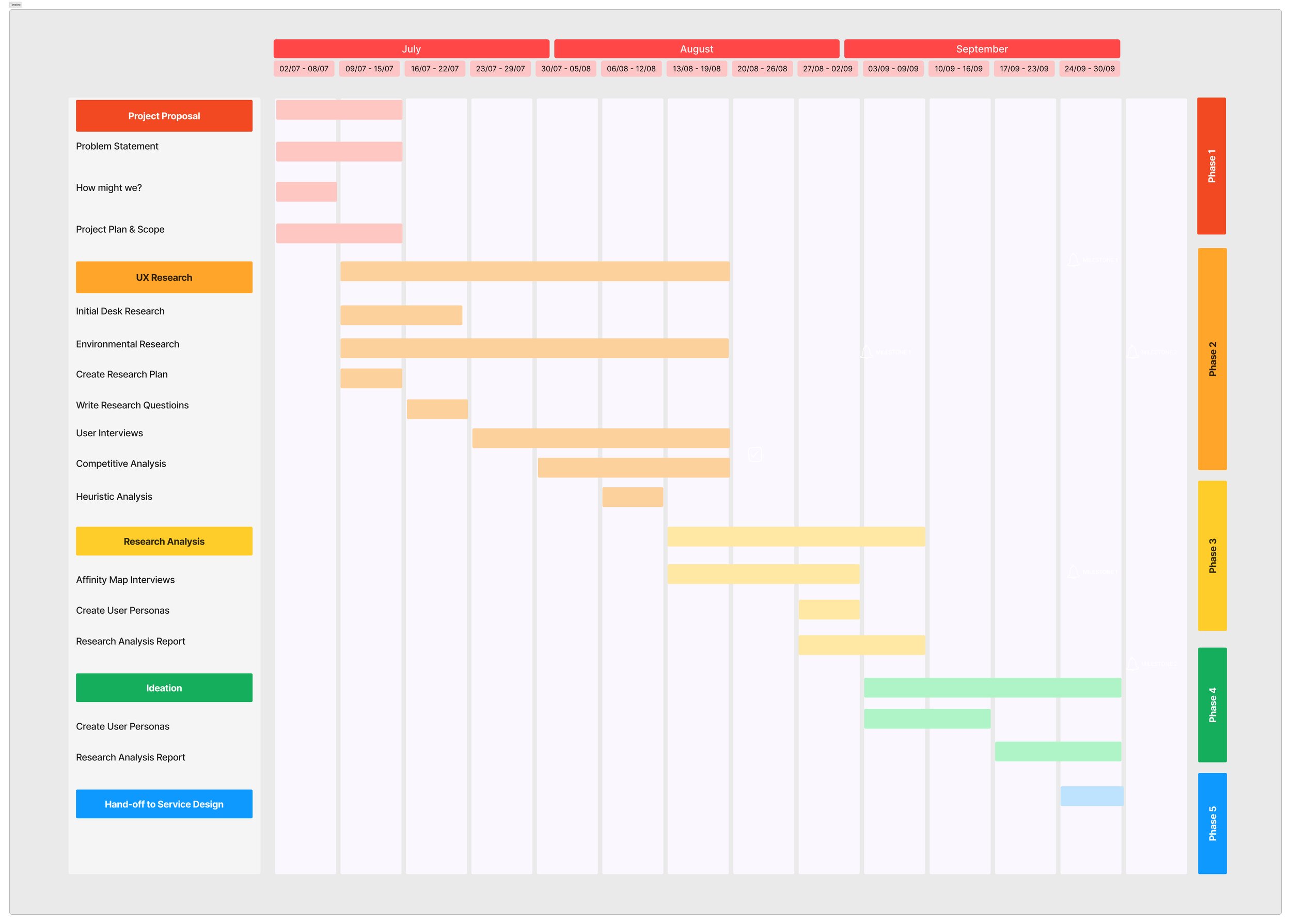
Project RoadmapMethodologies
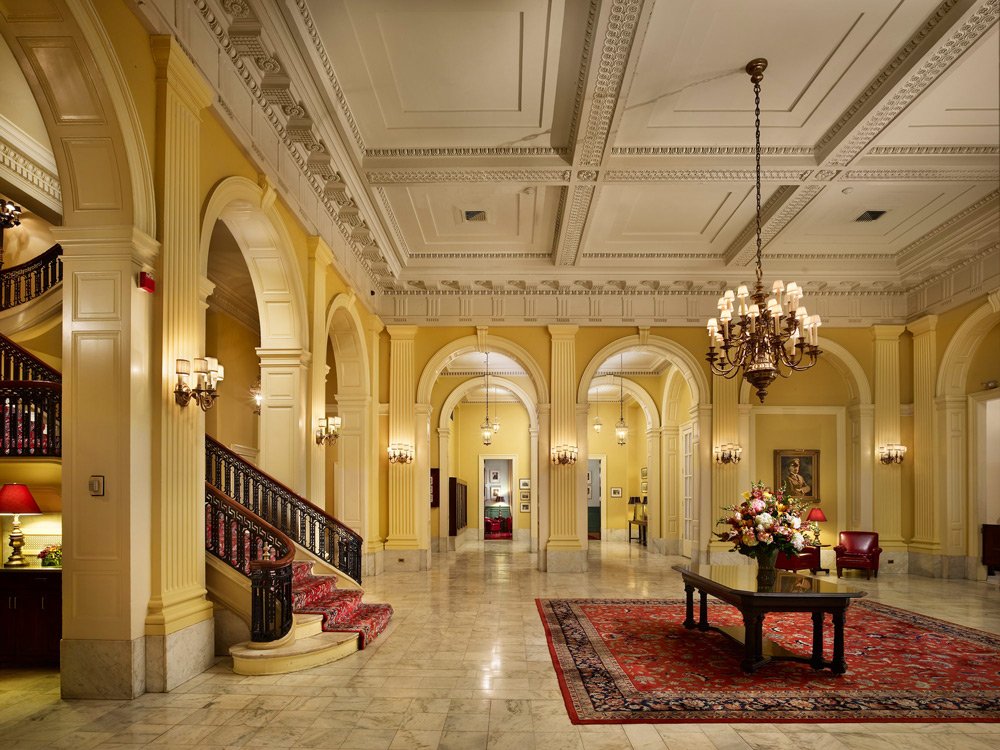
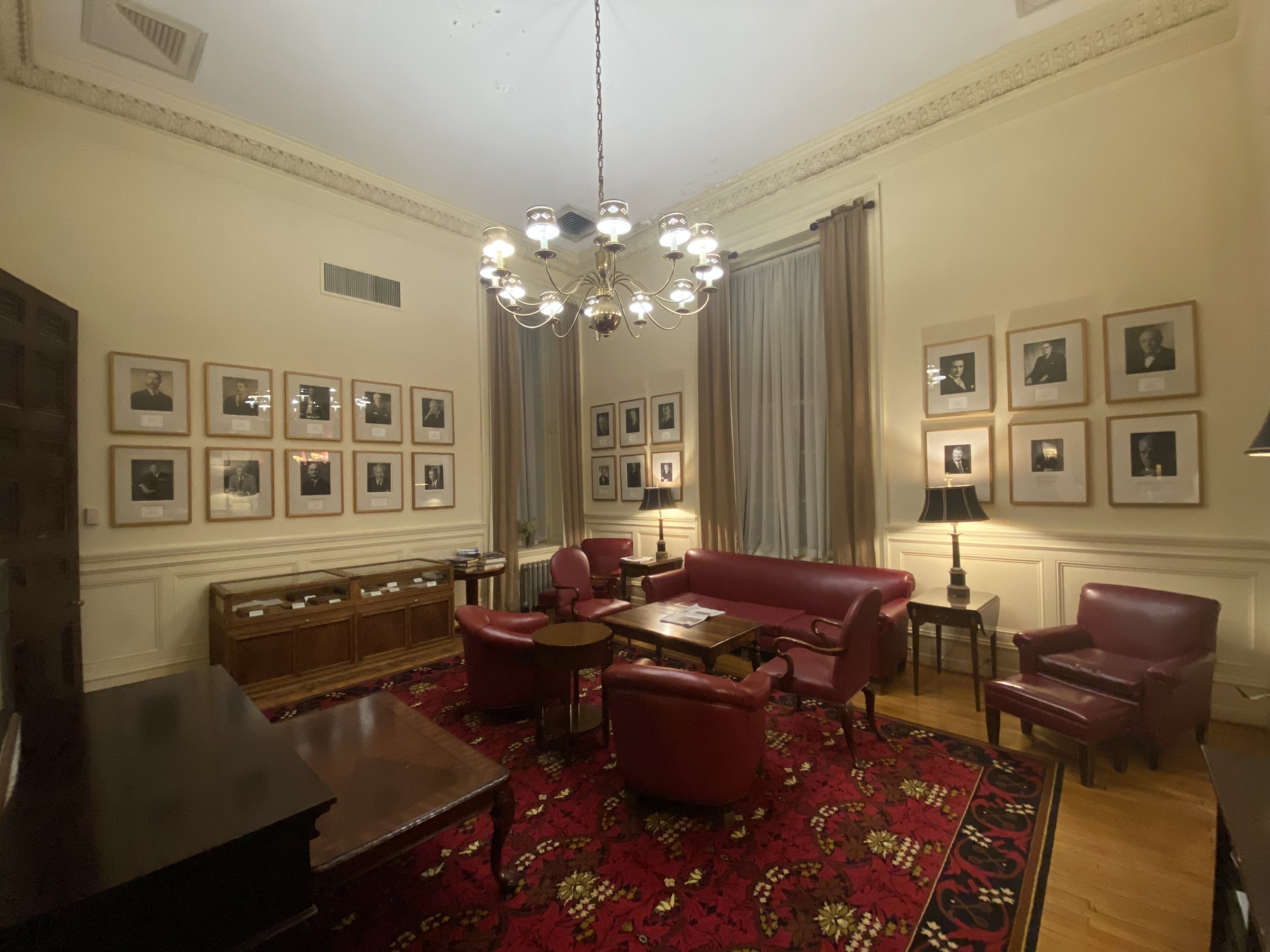
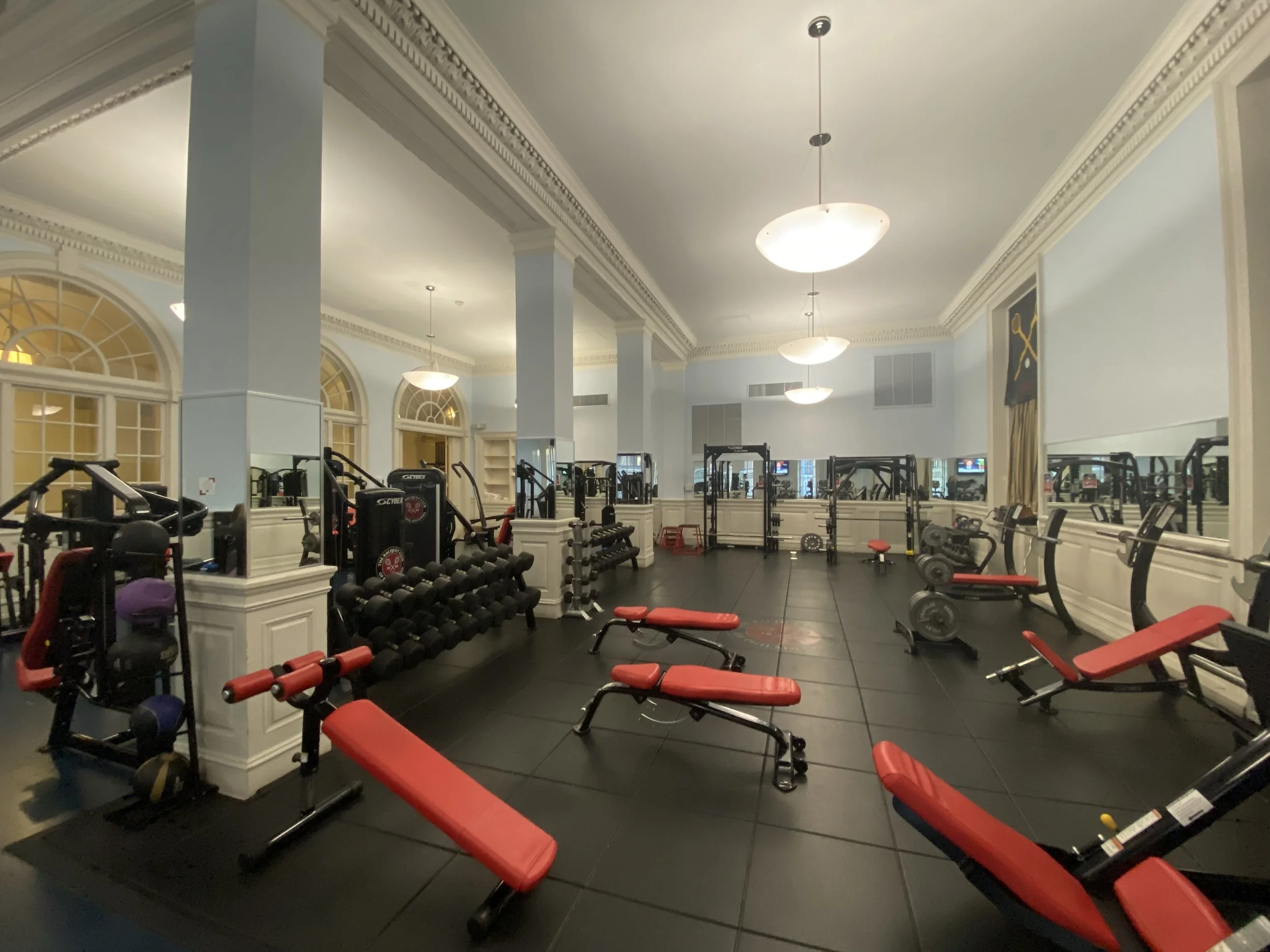
Environmental Research: I walked around the Club to conduct an environmental audit. I began by observing the practices and processes of the staff and members. Additionally, I observed the members and how they chose to use the Club.
Competitive Analysis: I performed a competitive analysis of both similar and adjacent clubs or membership services. Using both indirect and direct competitors provided a well-rounded view into the current offerings within the space and where there was room for improvement.
Exploratory User Interviews: In order to better understand the project's user types, I set out to create a detailed interview for Playing and House members. My goal was to perform at least 30+ user interviews for this project because the problem statement was quite broad and I wanted to narrow my focus within the problem space.
Affinity Mapping: After each user interview was completed, I created an affinity map using FigJam. In the affinity map, I color-coded each interviewee’s notes (some had the same color) under each user's name and then I began creating clusters on the other side. This allowed me to easily visualize what points were discussed the most as I moved into analyzing the information into key insights.
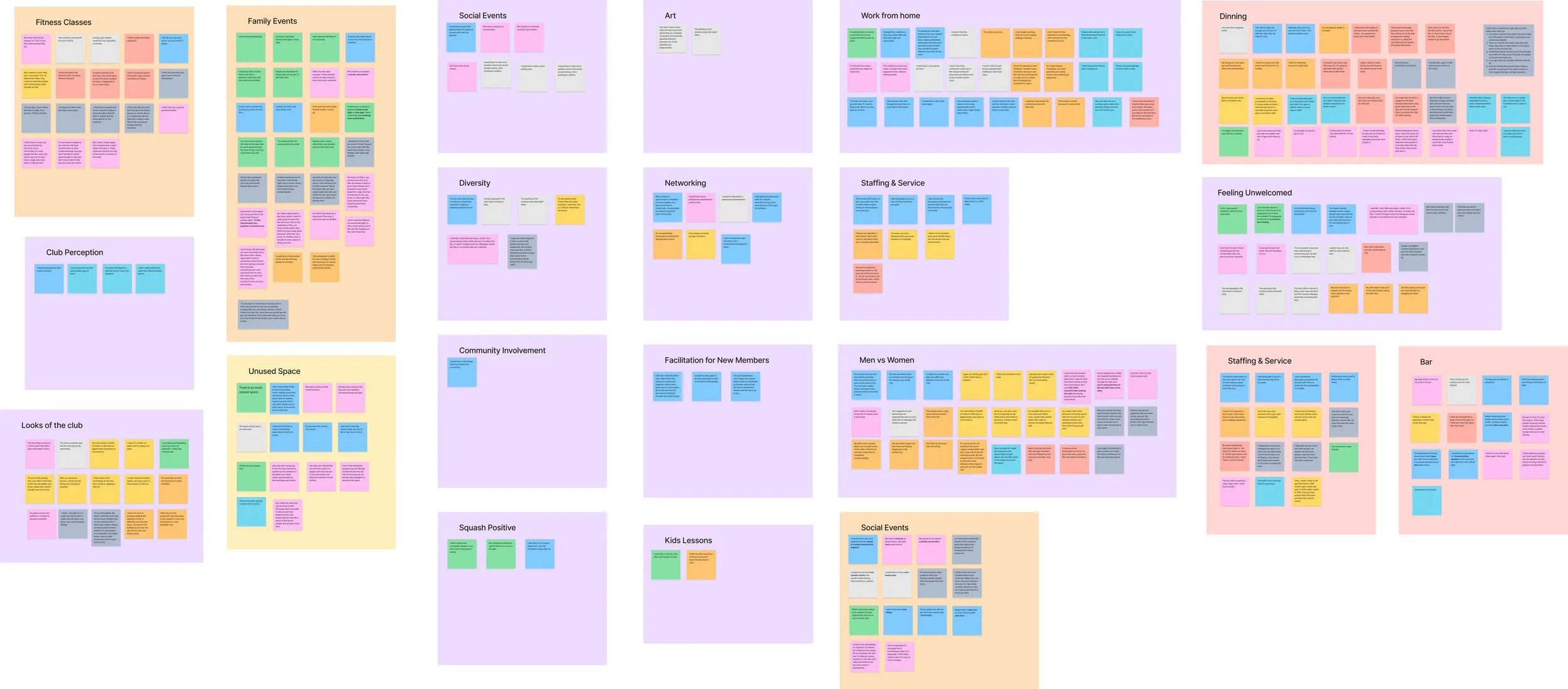
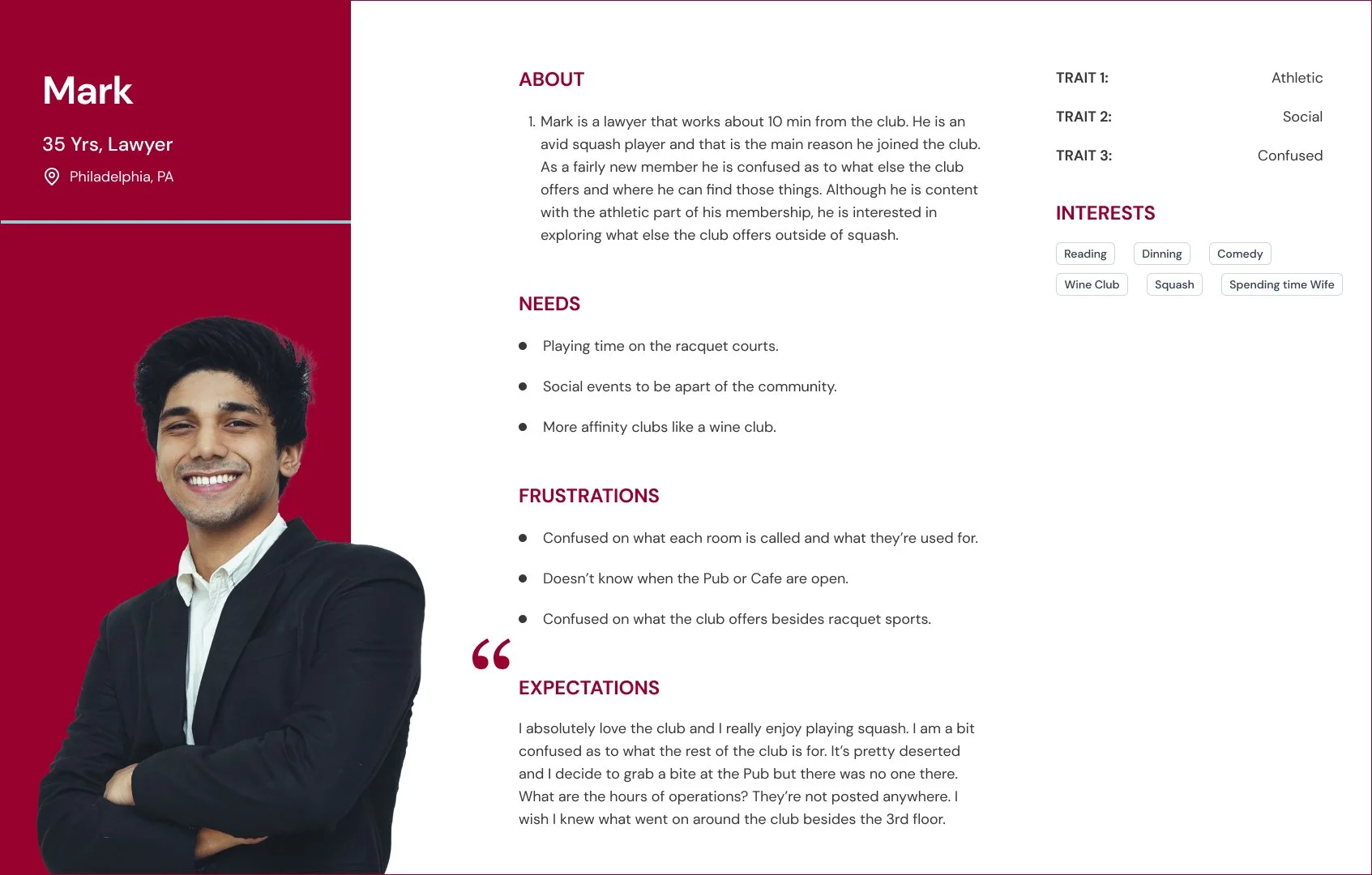
I organized all the insightful statements into clusters to notice larger patterns.User Personas: I created three user personas, one for each user type at the Club. The creation of these user personas allows stakeholders to better understand the user types as well as build empathy with the users.
Play squash and use athletic facilies
Occasionally attend social events
Mark The Playing Member
Insight 3
Users acknowledge the need to evolve from the traditional “old boys’ club”.
Insight 4
Users expressed dissatisfaction with the dinning experience and seek change.
Heuristic Evaluation: I completed a heuristic evaluation of the current version of the website. I captured screenshots of pages with problem areas and annotated them as needed. With the findings, I compiled a presentation highlighting suggested improvements. The most prevalent problems I discovered presented challenges in navigating the platform as well as containing errors on certain pages.
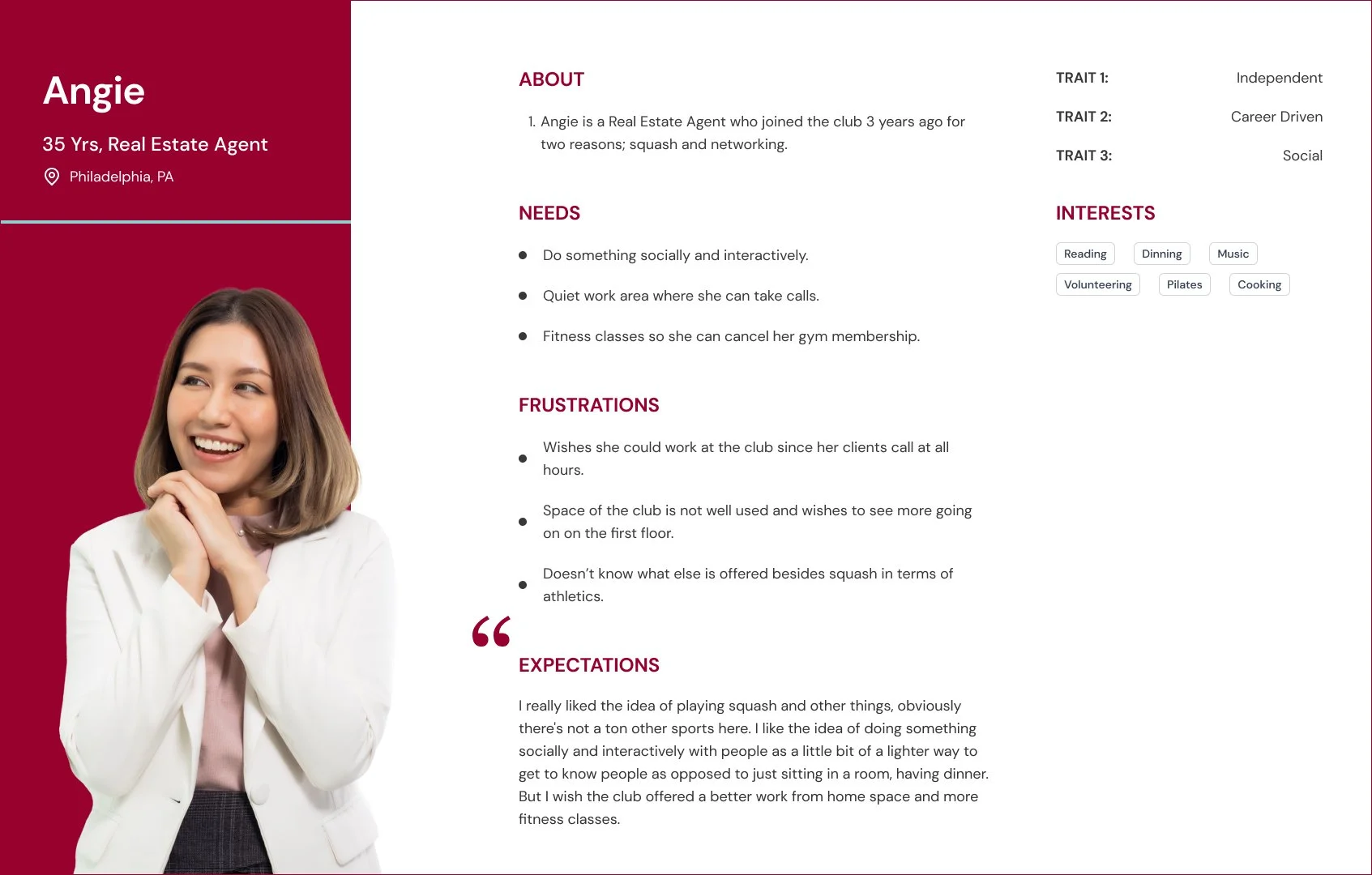
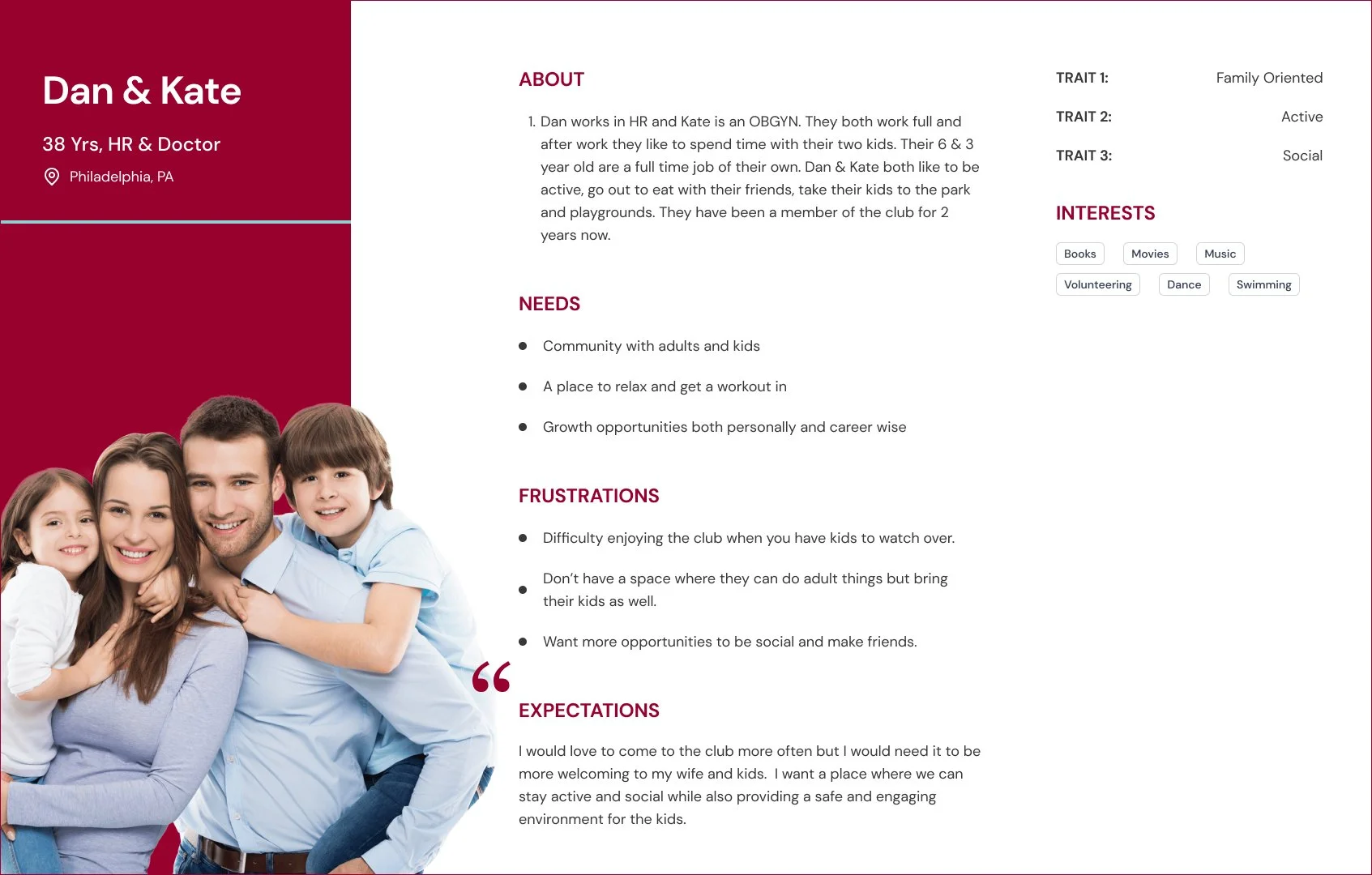
I developed three user personas to illustrate the diverse user types within the club, with the intention of broadening stakeholders' understanding beyond the traditional label of a Playing or House member. While these user personas represent distinct types of members, their involvement in the organization may overlap. As such, it is important for the club to ensure that all three personas are equally catered to and included in its activities and initiatives.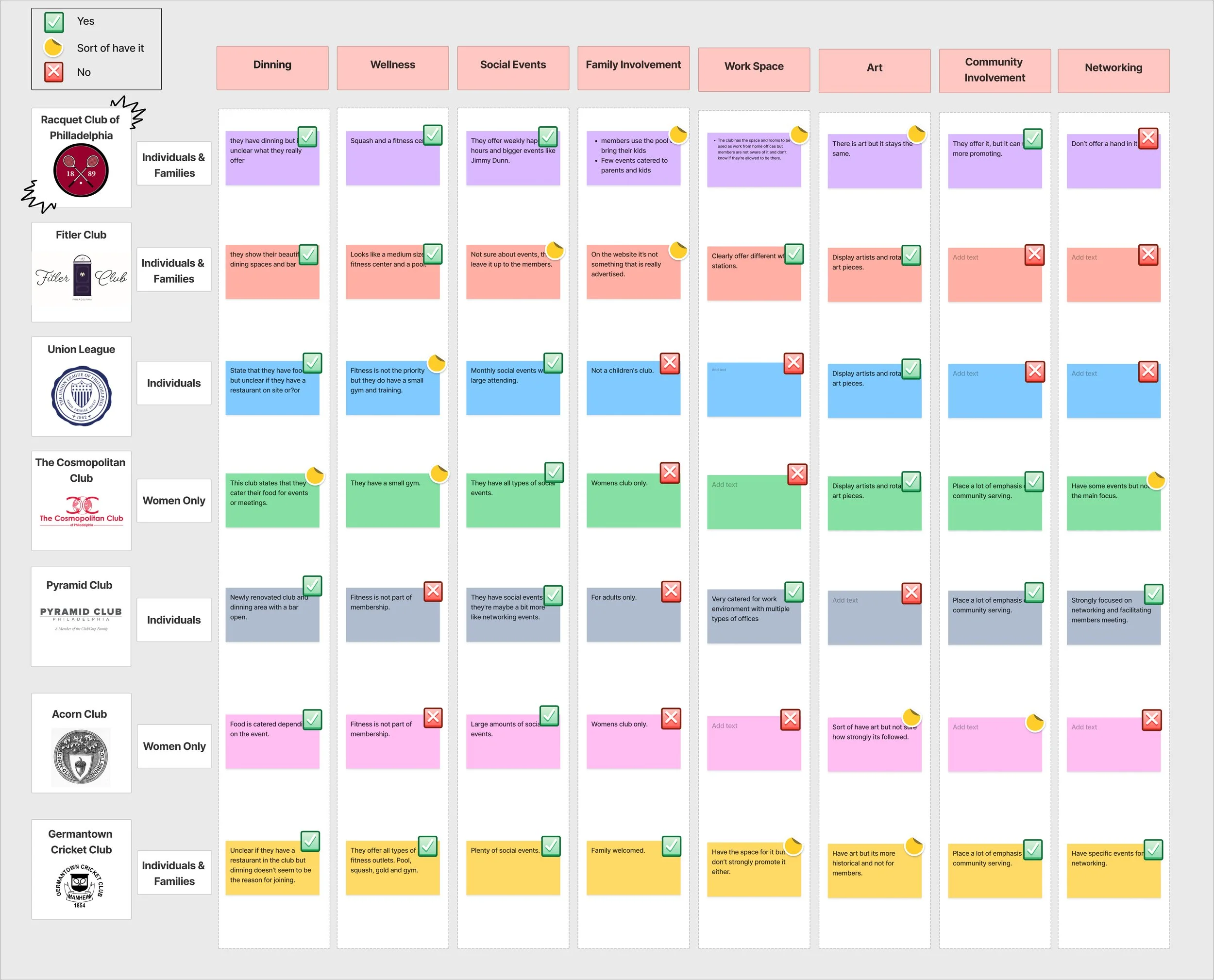
Conducted competitive analysis against 6 neighboring clubs, highlighting areas of improvement for the racquet club. The analysis revealed that the Racquet Club was lacking in family involvement, art, and community engagement compared to its neighboring clubs. These areas present opportunities for the club to improve and enhance its offerings to members.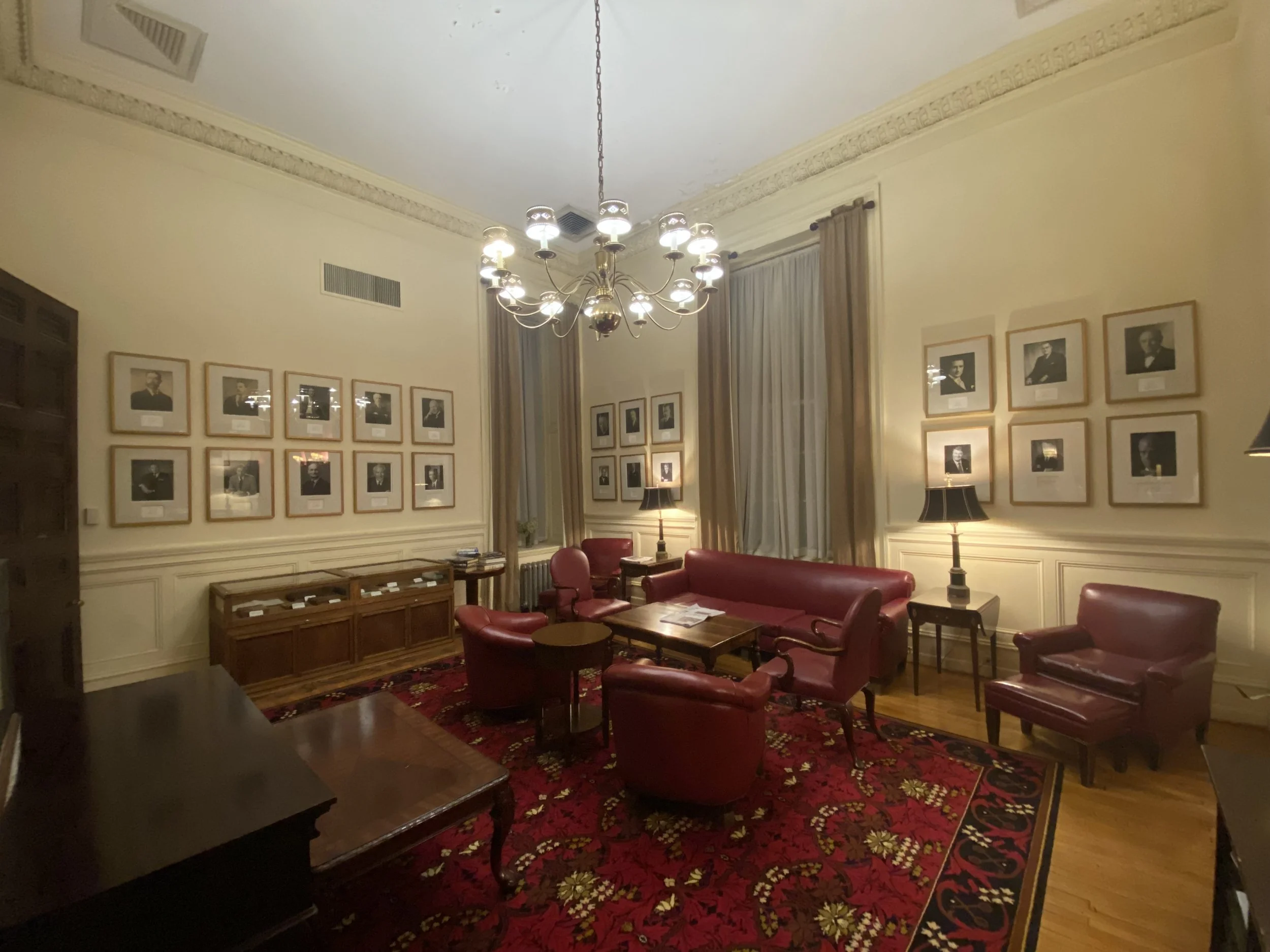
Location of User Interviews at the Club
3 interviews over Zoom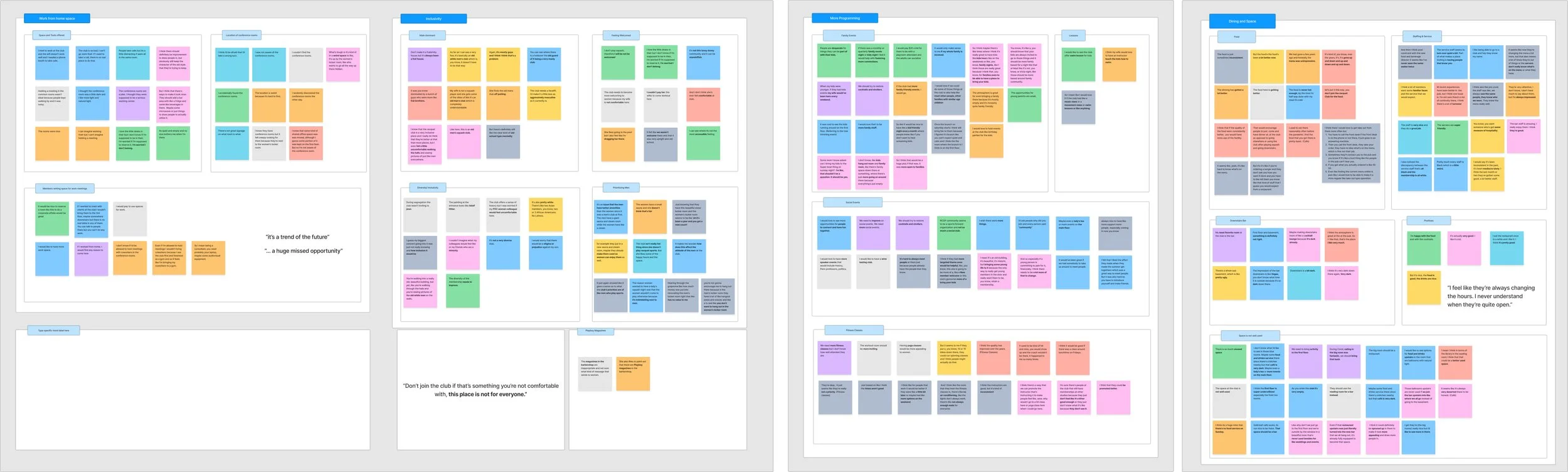
The insights were further categorized into 4 different categories which included more programming, work from home space, inclusivity and dinning. Insight 1
Users want more programming that revolves around social events, family and wellness.
Insight 2
Work from home space is a missed opportunity as it’s a trend of the future for users.
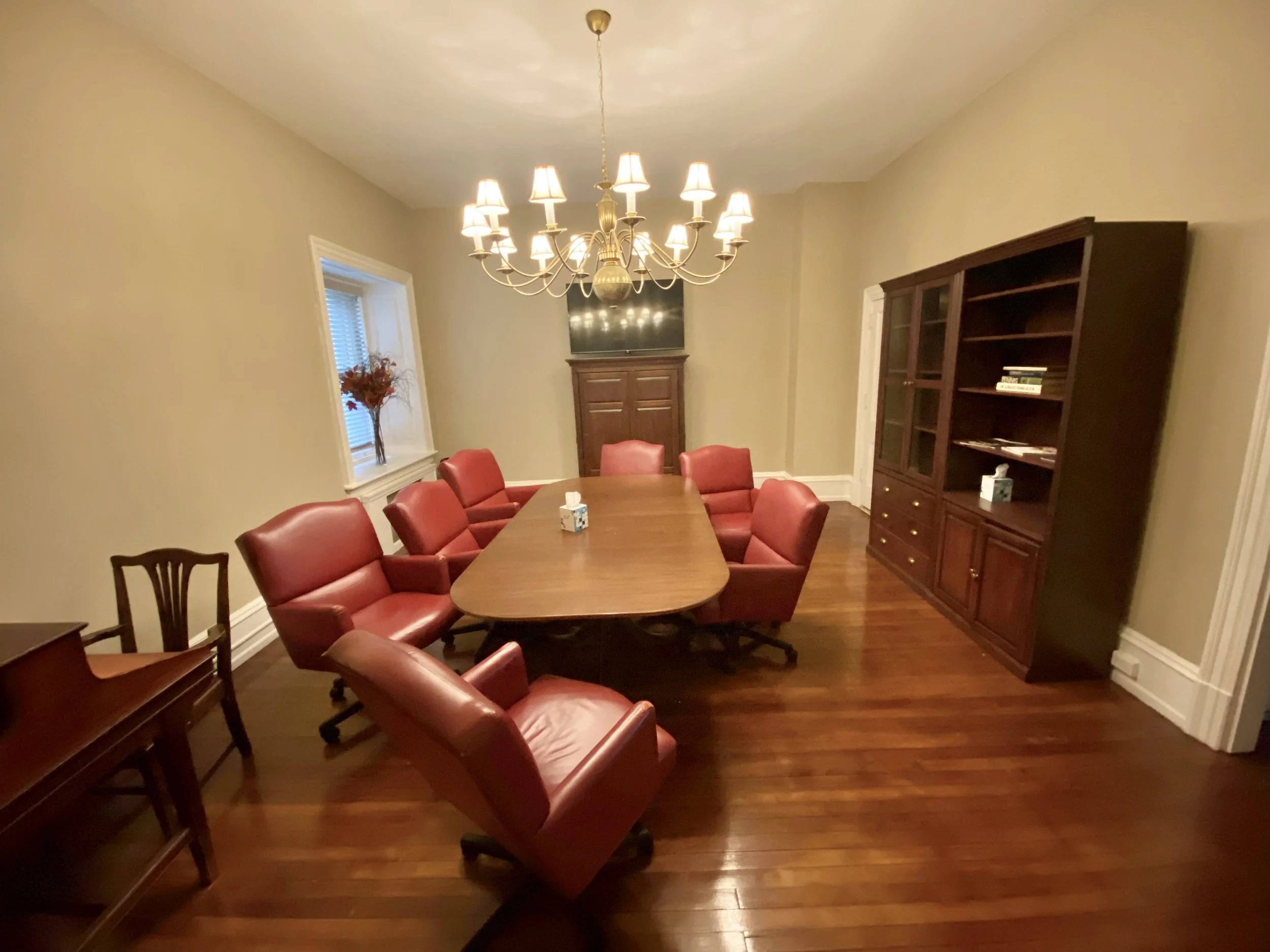
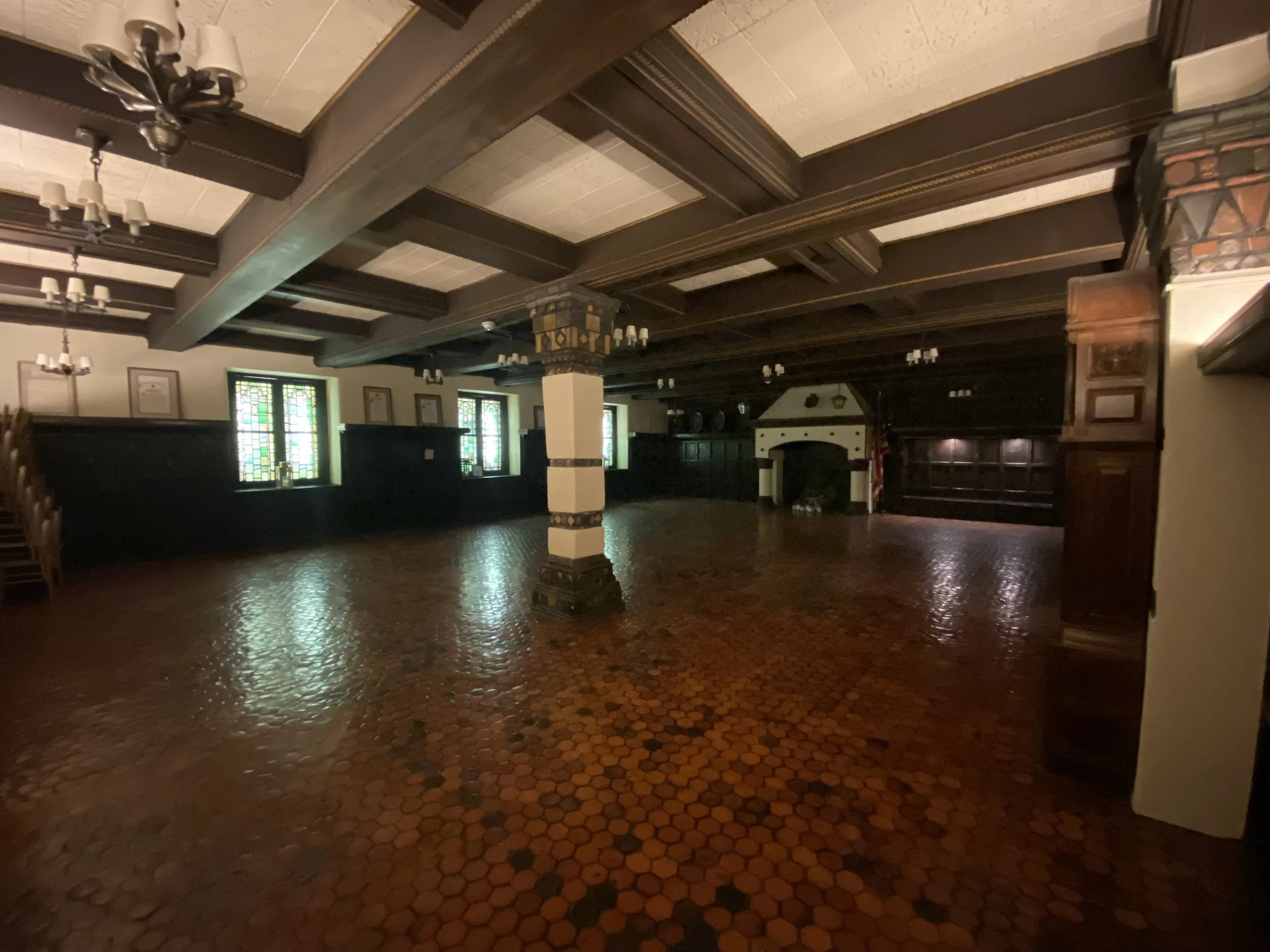
Here are some pictures taken while touring the Club. As you can see from the pictures, the club is mostly empty besides where the racquet courts are. This raised an immediate concern that caught my attention.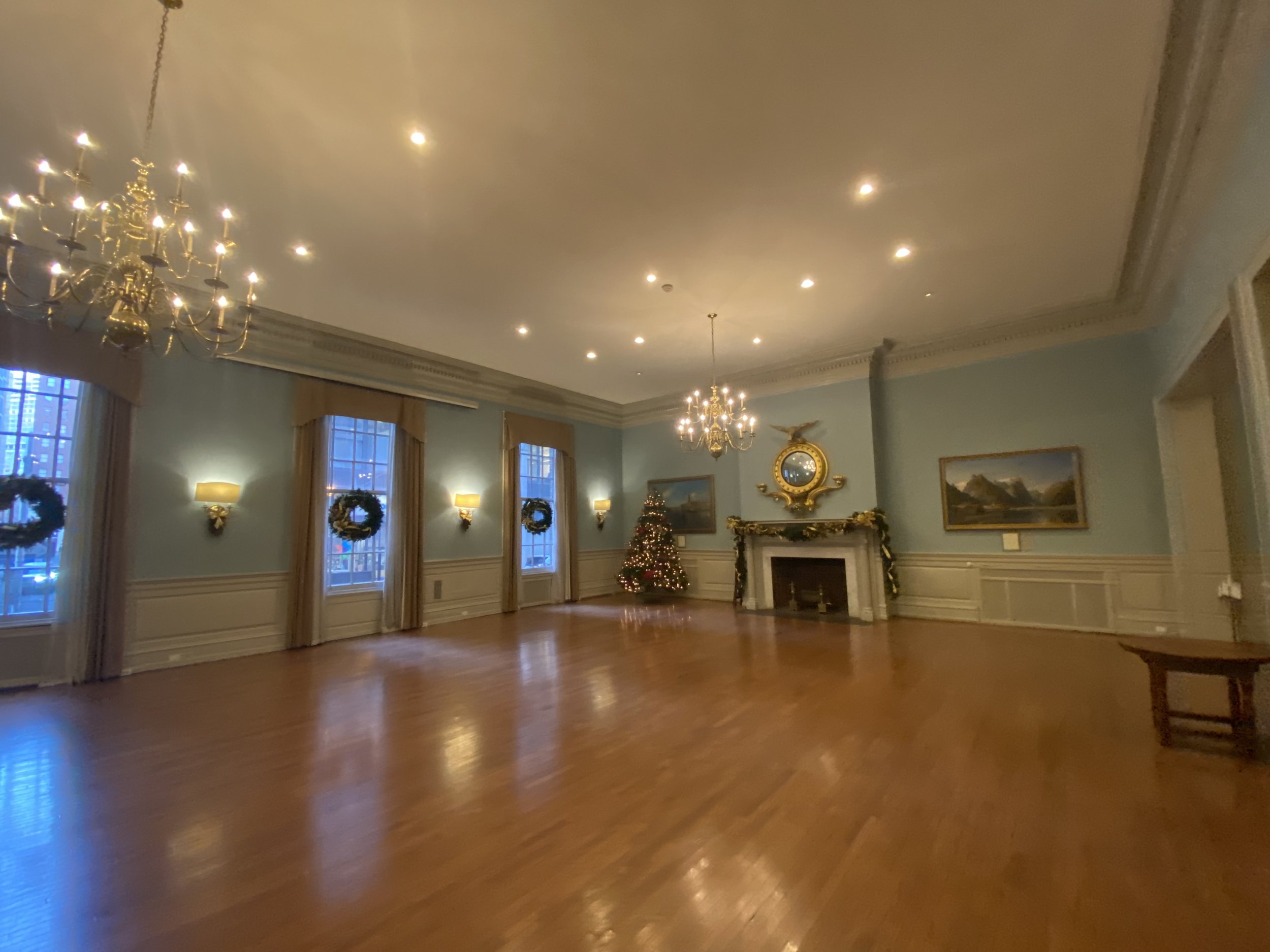
Problem 2
Poor navigation: Additional navigation is added on the right-hand side that is not included in the menu bar.
Problem 4
Poor content organization: The user must navigate multiple pages to understand the club's offerings.
Problem 1
Technical Error: Pub & Grille and Café Page are down.
Problem 5
Technical Error: Provisional membership page is down.
Participate in social and interactive circles.
Different types of fitness classes
Quiet work space to work from home.
Angie The House Member
Problem 3
Dated visual elements: The design doesn’t meet current design standards.
What are the priorities of three different user groups?
A community that involves adults and kids
Activity for each family member.
Dan & Kate The Family Members
Final Insights
There is a gap between squash players and non-squash-playing members.
On paper, distinguishing between House members and Playing members didn't provide enough differentiation between club users. Even when couples joined as Playing members, it was common for one partner to be a non-squash player. Our research revealed that non-squash-playing members desired more opportunities to socialize and connect with other members in order to feel more integrated and valued in the club community. This could involve events such as happy hours, ladies' tea, social gatherings, fitness classes, community service projects, and other activities.
Women’s experiences and the need for change.
Previously, the club had been primarily geared towards male members, and this was reflected in the amenities, events, and activities offered. Many users, both male, and female commented on the disparities between what the club provided for men versus women, which contributed to a feeling of exclusion and a lack of inclusivity for female members.
Members want a space at the club where they step away and get some work done.
Since the pandemic, there is a large increase in people working remotely. Many club members are looking for a quiet and comfortable space to take phone calls or work on their laptops either between squash games or as an alternative to their home office.
Users want more family-friendly events and activities to allow parents to stay engaged and be active members while also meeting the needs of their children.
This is because many parents found it challenging to balance their desire to stay an active club member and be connected to the community with the demands of caring for their children. Research showed that parents often had to take turns doing child care while the other partner can enjoy the club. This sometimes leads to the squash-playing parent enjoying the club more than the non-playing squash member.
Research Impact
User Impact:
The research highlighted the gaps between squash players and non-squash-playing members that weren’t visible to stakeholders prior.
Non-squash-playing members wanted more opportunities to socialize and connect with other members to feel more involved and welcomed in the club community.
Highlighted the need to focus on family units as a whole to improve users' ability to be active members while also meeting their child’s needs.
Business Impact:
Provided opportunities to help the club outcompete its rivals and increase its membership base.
Creating a tailored and user-centered experience led to increased, satisfaction, and loyalty among users, driving growth and revenue for the business.
Ongoing research efforts help the club stay ahead of the competition by staying up to date with evolving user needs and expectations.